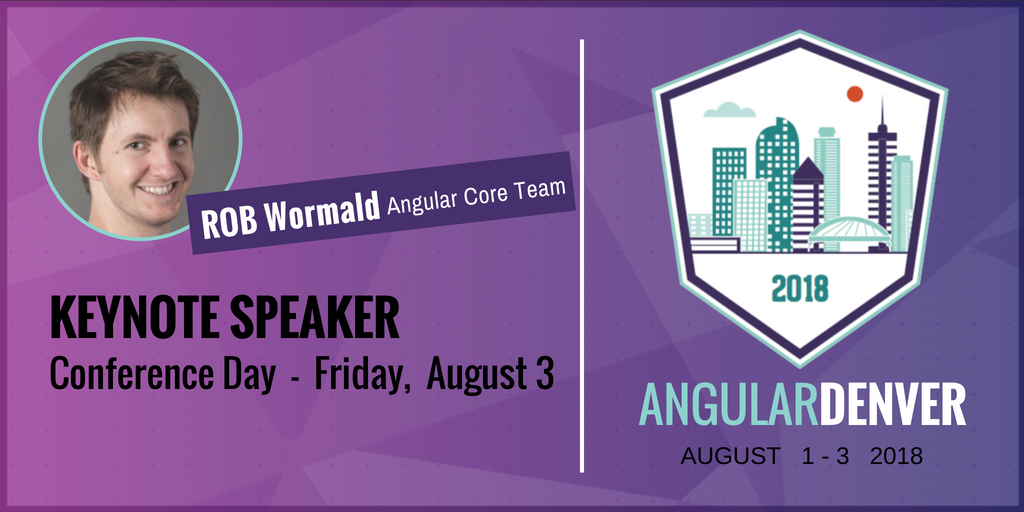
Friday, August 3rd
9:10 a.m. in the Marco Polo Ballroom, Curtis Hotel
Rob is a Developer Advocate on the Angular team at Google. He’s the Angular team’s resident reactive programming geek and founded the Reactive Extensions for Angular project, ngrx.
Connect with him on social:
Twitter/@robwormald
GitHub/robwormald

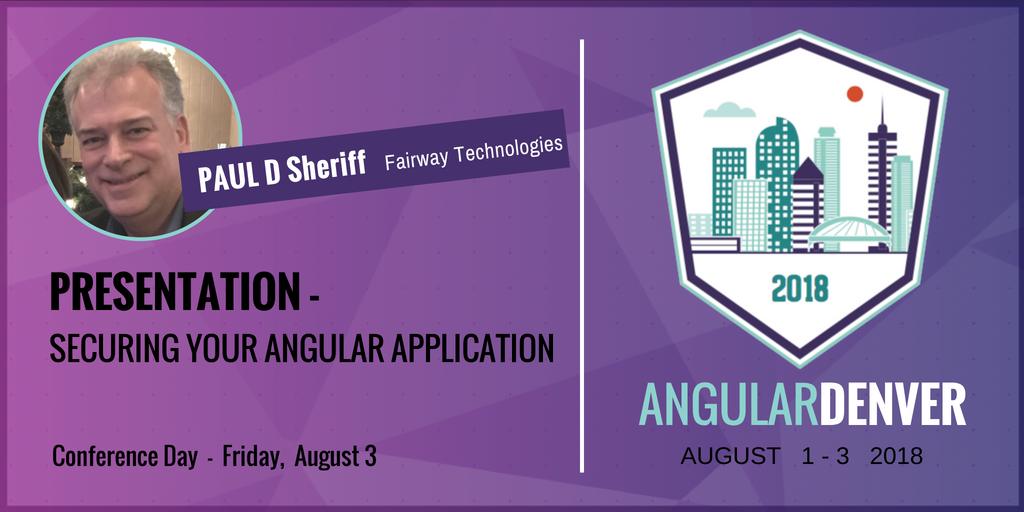
Friday, August 3rd
Four Square Ballroom, Curtis Hotel
Presented by: Paul Sheriff
Most business applications require a user to log in before they can use an application. In addition, menus and pages should only be available to certain users. This seminar shows you step-by-step how to secure menus using a security service and lock routes using an Angular Guard. You build an ASP.NETCore Web API and retrieve security data for a user. JSON Web Tokens are a simple and effective method of securing your Web API methods. You learn to integrate this tool into your Core Web API project and secure your methods. Learning Objectives:

Friday, August 3rd
Four Square Ballroom, Curtis Hotel
Presented By: Sam Brennan
In this talk we will go over how to take your animations to the next level. By using reusable animations, your project will not only be more efficient but more manageable than it was before learning these best practices.

Friday, August 3rd
Marco Polo Ballroom, Curtis Hotel
Presented by: Ado Kukic and Chris Sevilleja
Can you really have too much performance? In this talk we examine common and uncommon pitfalls that Angular developers fall for everyday and ways around them. We’ll analyze, debug, run performance tests, and improve the performance of a poorly written Angular application and show the difference even small optimization wins can make.
Friday, August 3rd
Marco Polo Ballroom, Curtis Hotel
Presented by: Mike Ryan
NgRx is a Redux-inspired framework for Angular applications. It manages state and side effects, helping you build applications that are easier to test, strongly typed and more performant; however, these benefits can add complexity. Luckily, there are a set of hard rules and principles that will guide you through these tradeoffs.

Friday, August 3rd
Four Square Ballroom, Curtis Hotel
Presented by: Sam Julien
There are tons of resources out there on *how* to upgrade from AngularJS to Angular, but no one ever talks about how to approach such a monumental task – and if you even should. How do you figure out where to start, which path to take, and whether it’s even worth it for you or your company to spend the time and money? Should you do a top-down, bottom-up, upgrade shell – or just rage-flip your desk over and rewrite everything in Perl? Should you rewrite your architecture first, or your build process? And how do you show the business side of things that spending hundreds of hours on technical debt is actually worth it – even if you’re not adding any functionality? In this talk, you will learn the WHY and the HOW of each building block of the upgrade process for your application. I find that when teaching (rather than simply presenting information), if you can convey the thought process behind WHY you did something the way you did, as well as the payoff for making that decision, you get a greater understanding, acceptance and application of the student learning.This is the meta-level talk I wish I had seen a couple of years ago: a toolbox I could use to identify the gaps in our app’s architecture and tooling, but also how to balance it against our budget and time constraints. Instead, I just had to throw stuff at the wall and see if it stuck – and try not to get fired along the way. The talk will include a game plan cheat sheet you can work through on your own and show your boss or your teammates.
Friday, August 3rd
Four Square Ballroom, Curtis Hotel
Presented by: Bonnie Brennan
This talk will introduce GraphQL and briefly explain this modern alternative to REST APIs. We’ll see how you can use all the awesome modern features (like RxJS!) even if you’re still dependent on an older database.

Friday, August 3rd
Four Square Ballroom, Curtis Hotel
Presented by: Alyssa Nicoll
If we aren’t doing it for the users, who are we doing it for? How often have you used something — or even more painfully, witnessed someone using something — that was poorly designed? Perhaps the creators did not fully think through their product. Perhaps they were lazy. Whatever the case, in the end, the user is the one who suffers.
As we go about building killer Angular apps to take over the world, it is vital that we keep in mind our users and their end needs. In this show, Alyssa will dive into the psyche of the user, the vitality of giving feedback, and how to use Animations in Angular to provide that feedback and create a seamless flow between user and technology.